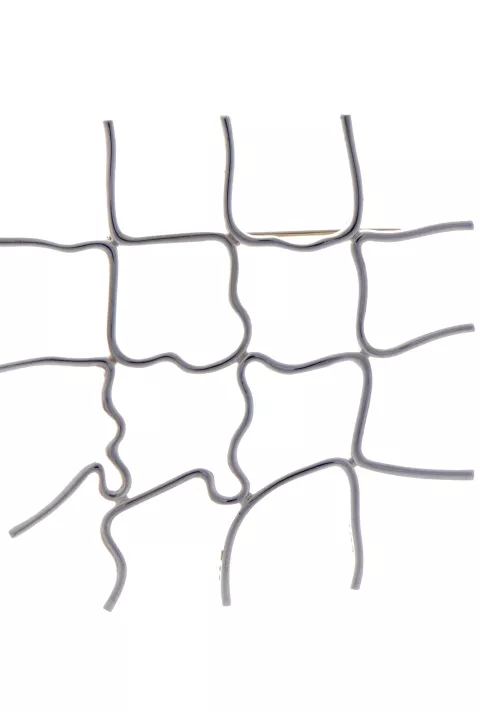
François Morellet
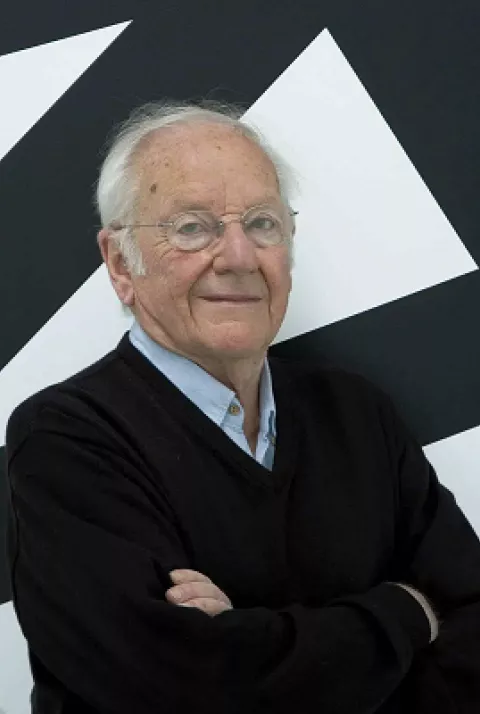
François Morellet (1926–2016), a prolific self-taught artist, developed a radical approach to geometric abstraction through his paintings, sculptures, and installations over a career spanning more than six decades. Working mainly with basic geometric shapes, Morellet committed himself to a methodology of rigorous objectivity and personal detachment, using multiple materials in his works (steel, neon tubes, adhesive tape, wire mesh, wood, etc.). He sought to control the creative process and demystify the romantic mythology of art and the inspired artist, justifying each of his choices with a pre-established principle, which could even involve chance in certain components of the work. Morellet's playfulness and humor are also evident in the titles of his works, which often contain puns, parodies, or portmanteau words.
Born in Cholet, France, where he lived and worked his entire life, Morellet studied Russian at the École des Langues Orientales in Paris before returning to run the family toy factory until 1975. This activity allowed him to gain financial independence while familiarizing himself with the tools and production techniques that influenced his practice. After a brief figurative period in the 1940s, Morellet turned to abstraction following a highly influential trip to Brazil in 1950, where he discovered concrete art and the work of Max Bill. In addition to Bill, Mondrian and Theo van Doesburg became decisive influences on the artist, as did the geometric patterns, anonymous aesthetics, and precision of Islamic decorative art that he encountered during his visit to the Alhambra in Spain in 1952. In the late 1950s, he discovered the “Duo-collages” of Jean Arp and Sophie Taeuber-Arp through his friend Ellsworth Kelly, which prompted him to introduce chance as a central principle, creating works based on random numbers found in his local phone book or on the infinite sequence of decimal places of the number pi.
Until 1960, Morellet established the various systems of arrangement of forms that he used (superimposition, fragmentation, juxtaposition, interference), notably by creating his first “trame,” a network of black parallel lines superimposed in a specific order.
Morellet was one of the founding members of the Groupe de Recherche d'Art Visuel (GRAV) along with five other artists, Francisco Sobrino, Horacio Garcia Rossi, Julio Le Parc, Yvaral, and Joël Stein, a collective of experimental artists that emerged in France in the early 1960s. He also participated in the international New Tendency movement. In this context, he sought to create experimental art based on scientific knowledge of visual perception and developed collectively. After 1970, he entered a period marked by the creation of increasingly minimalist works that played with their medium and the space surrounding them. He also produced a large number of architectural integrations, starting with his first monumental work on the Plateau de la Reynie in Paris, on the site of the current Centre Pompidou, in 1971.
Morellet's work has been included in a number of important international group exhibitions, notably Documenta in Kassel, Germany (1964 [with GRAV], 1968, and 1977) and the Venice Biennale (1970 and 1990). In 1971, his first solo museum exhibition was organized by the Stedelijk Van Abbemuseum in Eindhoven, Netherlands, and subsequently traveled throughout Europe. Other major retrospectives of Morellet's work were held at the Nationalgalerie in Berlin (1977), the Centre Pompidou (1986 and 2011), and the Galerie nationale du Jeu de Paume (2000) in Paris. He was also the subject of a North American retrospective in 1984-85, which traveled to the Albright-Knox Art Gallery in Buffalo, the Musée d'art contemporain de Montréal, the Brooklyn Museum, and the Center for the Fine Arts in Miami. In 2010, Morellet became the second artist to have a work displayed in the Louvre Museum during his lifetime with the inauguration of a permanent in situ installation entitled L'esprit d'escalier. His work is represented in major public collections, including the Centre Pompidou, the Dia Art Foundation (New York), the Los Angeles County Museum of Art, the Museum of Modern Art in New York, the Seoul Museum of Art, Tate Britain, the Tel Aviv Museum, the Kunsthaus in Zurich, and the Nationalgalerie in Berlin.
François Morellet was the first artist published by MiniMasterpiece in early 2012, when the gallery opened. Thank you, François!