Barthélémy Toguo
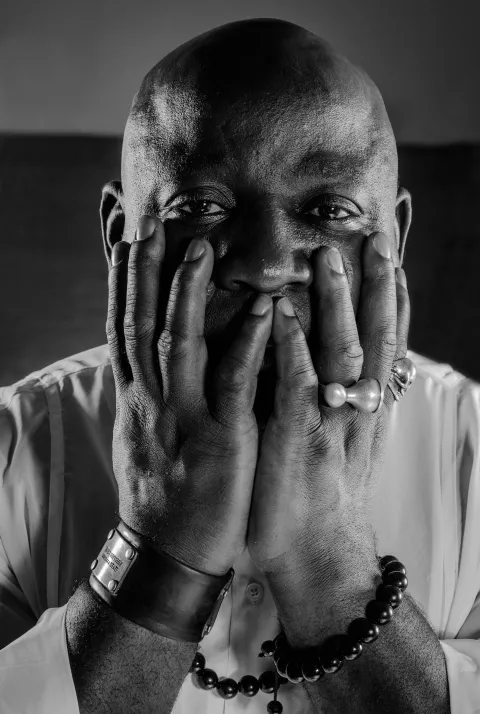
Barthélémy Toguo was born in Mbalmayo, Cameroon, in 1967. He lives and works between Paris and Bandjoun (Cameroon).
Between 1989 and 1993, he studied fine arts, first at the École des Beaux-Arts in Abidjan (Ivory Coast), then in Grenoble (France), and finally at the Kunstakademie in Düsseldorf (Germany), where he met Tony Cragg, Jannis Kounellis, and Konrad Klapheck. Although he settled in Europe and became a French citizen, Barthélémy Toguo remains deeply rooted in Cameroon, where he returns very regularly. There he created Bandjoun Station, a foundation inaugurated in 2013 designed to welcome artists and researchers from around the world to live and work in studio apartments, developing projects in harmony with the local community. In this way, Bandjoun Station will become a crossroads, a true meeting place between classical and contemporary art. He is also developing agricultural projects there in a spirit of sustainable and healthy development.
Since the early 1990s, his work has developed across multiple media: initially photography and video, then performance, watercolor, and sculpture. With humor, provocation, and poetry in equal measure, Toguo tackles themes that are dear to him, such as politics and migratory flows, whether human or commercial.
In the late 1990s, Toguo's work caught the attention of several critics and curators, who invited him to participate in major events: Hans Ulrich Obrist in 1999 for “Migrateurs” (ARC, Paris), Jean-Hubert Martin in 2000 for "Partage d'exotismes “ (Lyon Biennale), Pierre Restany in 2001 for ”Political Ecology“ (White Box, New York), and Okwui Enwezor in 2015 for the Venice Biennale, ”All the World's Future." In 2016, Barthélémy Toguo was one of four artists nominated for the Marcel Duchamp Prize and, on this occasion, he presented the installation “Vaincre le virus !” (Defeat the Virus!) at the Centre Pompidou. In 2018, he had a solo exhibition, “The Beauty of our Voice,” at the Parrish Art Museum in New York. Subsequently, in 2021, Barthélémy Toguo presented a solo exhibition at the Quai Branly, “Désir d'Humanité” (Desire for Humanity). In 2022, he presented a 10-meter-long ink on canvas entitled “The Generous Water Giant” at the Sydney Biennale. That same year, Barthélémy Toguo was invited to create a large-scale installation under the Louvre pyramid, “Le Pilier des migrants disparus” (The Pillar of Missing Migrants). In 2025, he participated in the group exhibition “Where Are We Now: Highlights of the Miettinen Collection at Philara Collection” in Düsseldorf.
Toguo's works are included in numerous collections, including those of the Musée National d'Art Moderne (Paris), the Bibliothèque Nationale de France (Paris), the MAC/VAL (Paris), the Tate Modern (London), the Museum of Modern Art (New York), the Museum of Contemporary Art (Miami), the Pérez Art Museum (Miami), the Chazen Museum of Art (University of Wisconsin-Madison, USA), the Parrish Art Museum (Water Mill, USA), the Fondation Louis Vuitton (Paris), and the Collection Agnès b. (Paris). The artist recently received a long-term commission for four door panels at the Musée Rodin (Paris).
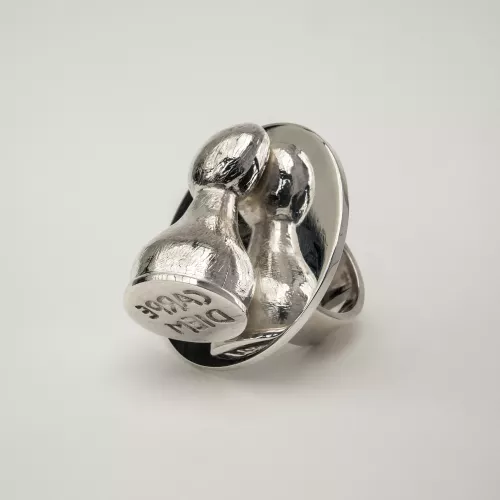
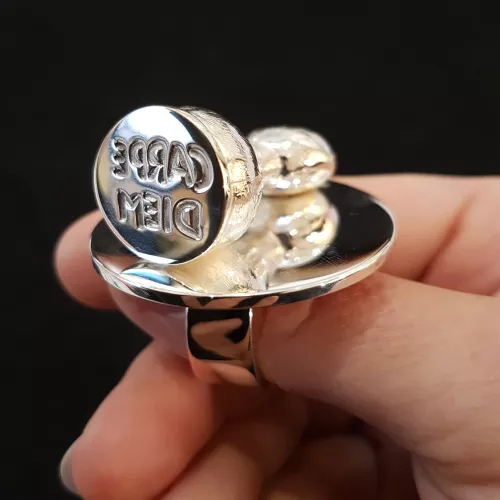
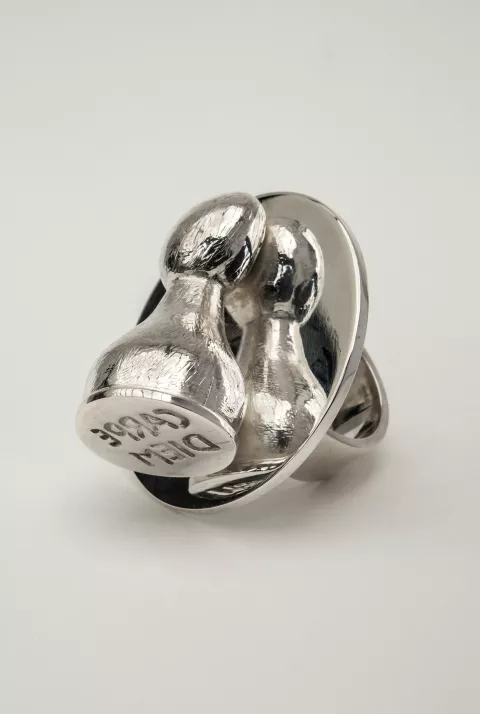
In 2013, the gallery approached him for a collaboration. The Carpe Diem ring is Barthélémy Toguo's very first piece of jewelry.
It is inspired by his famous carved wooden stamps and echoes his research on issues of identity and control.