Julio Le Parc
Julio Le Parc, born in Argentina in 1928, is an iconic figure in art history.
A pioneer of kinetic art and Op Art, he was a founding member of G.R.A.V. (Groupe de Recherche d’Art Visuel) alongside Horacio Garcia Rossi, Francisco Sobrino, François Morellet, Joël Stein, and Jean-Pierre Vasarely (Yvaral). Winner of the International Grand Prize for Painting at the Venice Biennale in 1966, he remained a committed artist throughout his life. A defender of human rights, he fought against dictatorships in Latin America. He was expelled from France in May 1968 for his participation in the popular workshop and his demonstrations against institutions. A strong-willed personality, in 1972 he refused a retrospective at the Musée d'Art Moderne de la Ville de Paris by playing it at heads or tails. He finally became a naturalized French citizen in the 1980s, where he lived and worked.
Since 1959, Le Parc has pursued his own path, applying rigorous principles to his paintings, whether to explore the use of color scales or infinite combinations. Beginning in 1960, Le Parc produced paintings based on systems of surface organization, correlations of forms, as well as vibratory reliefs and immersive installations. He has long been interested in audience participation and the instability of perception, paving the way for important work around light and movement in art. Le Parc is interested in the relationship between the artwork and the viewer, with the visitor no longer a passive and independent observer, but an active participant in an interactive experience.
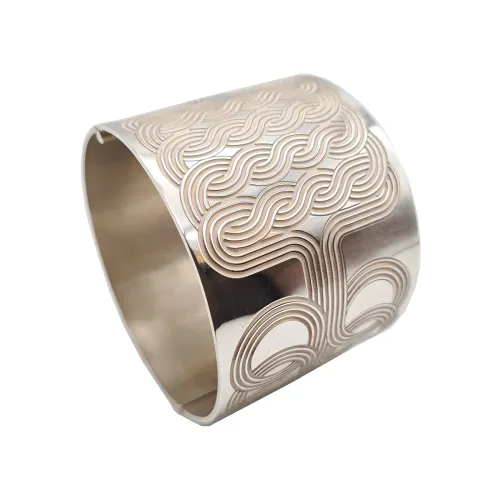
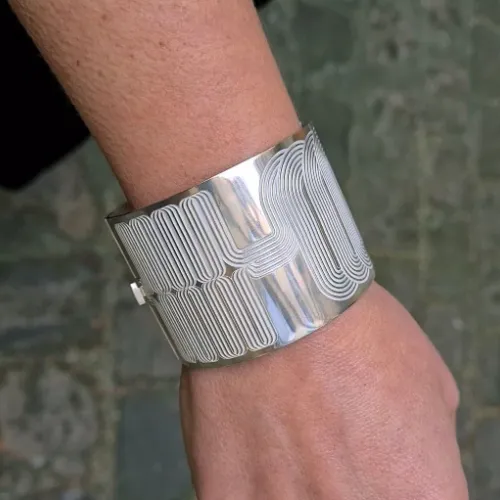
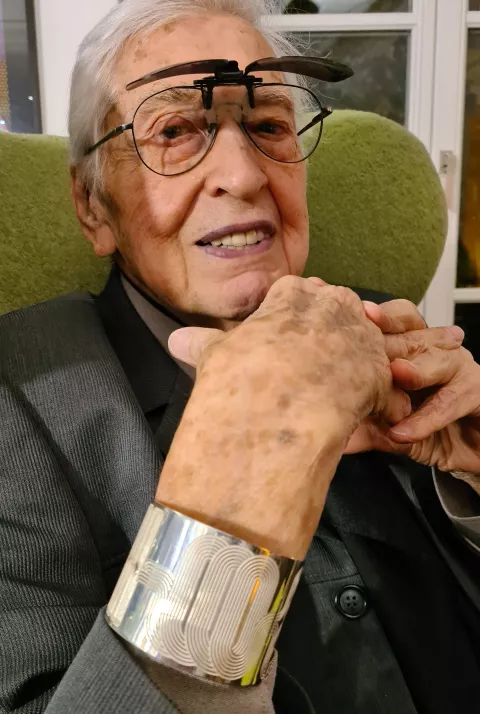
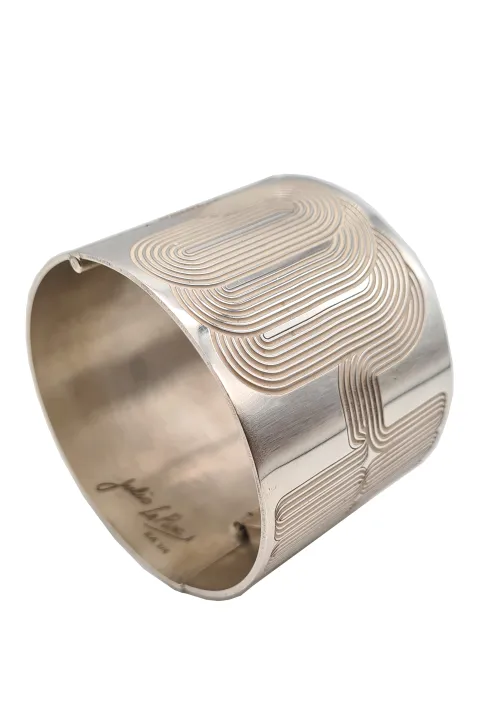
In 2022, he designed the engraved cuff Teabrazo for MiniMasterpiece, reworking the motif from The Long Walk, his monumental work from 1974. The fluid and continuous connection of forms in La Longue Marche suggests the idea of dynamic progression. The work could continue indefinitely, in space and time. This echoes Le Parc's own life, when as a young man he fled the Argentine dictatorship and began his long journey as a refugee that would take him to France. In the 2022 jewel, colors are replaced by deep engraving in solid silver. Multiple lines interact with each other through a deep groove in the material and become white in contrast to the mirror-polished surface of the bracelet.